 Free shipping on orders over £29,85
  Shipping Tracking!


 Google
 Facebook
How to calculate how much epoxy resin is needed for a table?
Step-by-step method to accurately estimate resin for tables
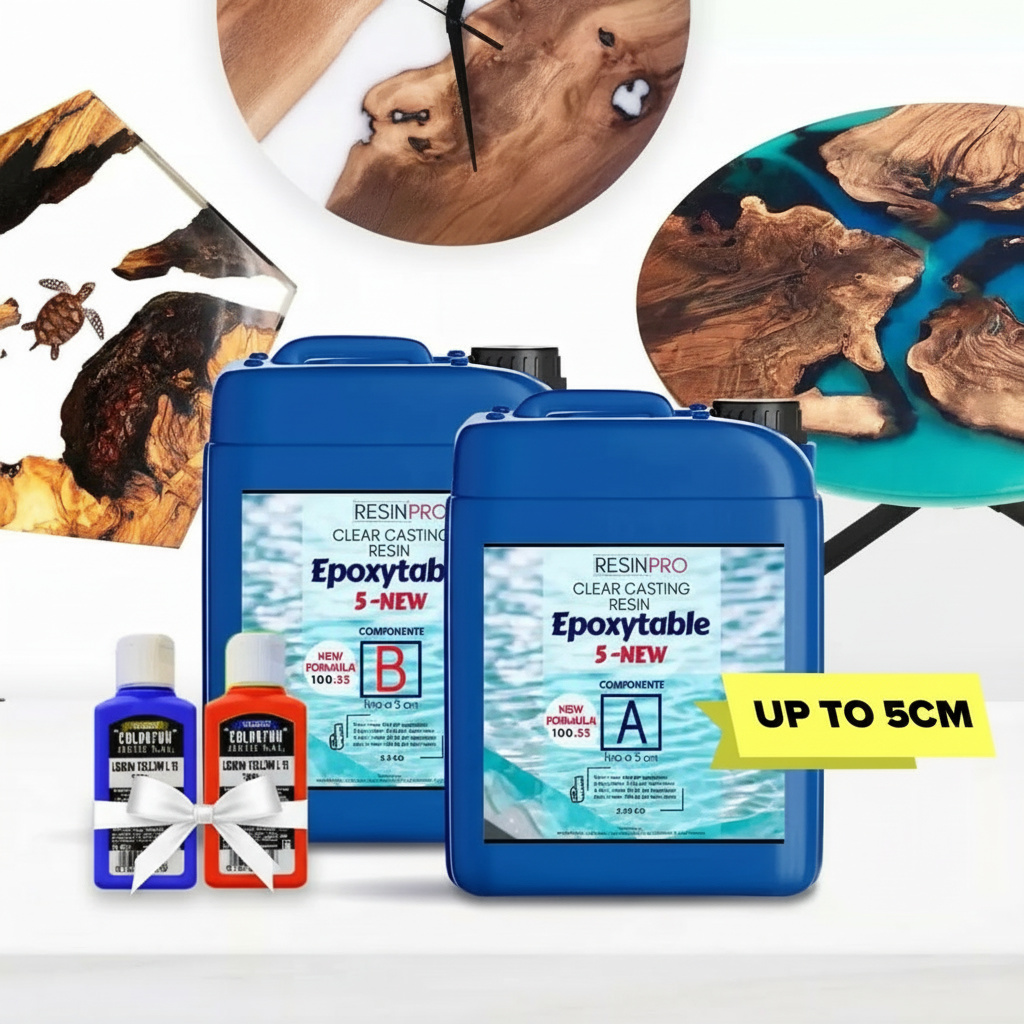

Calculating the exact amount of epoxy resin for a table project ensures you achieve a flawless finish without costly waste or coming up short during pouring. Whether you’re crafting a stunning river table or sealing a classic wooden surface, following the right method makes all the difference in the quality and efficiency of your result.
What You’ll Need
- A tape measure or ruler
- A calculator
- A notepad for recording measurements
- A disposable container for test volume, if needed
- “EpoxyTable 5-Five” – Deep Pour Epoxy Resin for Tables and Large Projects – Up to 5cm (for classic deep pours or river tables)
- “Epoxytable 10-Ten” – Deep Pour Epoxy Resin for Tables, Up to 10cm Casting (for super-thick or larger resin elements)
- “Trasparente” – Multipurpose Clear Epoxy Resin for Casting – Up to 2cm (for thin coats, art or small woodworking tables)
- “River-Table” – Complete Kit for Creating Your First Epoxy Resin Table (if you need a ready-made solution for your first project)

Understanding Table Types and Resin Depth
River tables and traditional wooden tables require slightly different calculations. For river tables, measure only the area to be filled with resin, not the complete surface. For classic wood coating, use the entire tabletop’s length, width, and target resin thickness. Select your resin type based on maximum recommended pour depth for clarity and strength.

Step 1: Take Precise Measurements
Accurate measurements are the foundation of a professional result. Begin by carefully measuring the length and width of the area you plan to fill with resin. If you are making a river table, measure both the total table size and the exact width of the resin ‘river’. For classic surfaces, measure any space intended for clear or coloured resin pouring.
Always measure the table’s length, width, and average depth to the nearest millimetre. Depth is particularly important: measure at several points and use an average if the surface is not perfectly level.
Step 2: Calculate the Required Resin Volume
Multiply the length (cm) by the width (cm) by the resin pour depth (cm) to get the total volume in cubic centimetres (cm³). This is the standard calculation for a flat, rectangular area. For irregular shapes, break the area into simple rectangles, calculate each volume, then add together. For round or alternative shapes, use the mathematical formula for that form (such as π x radius² x height for a circle).
Calculate the total volume in cubic centimetres (cm³) for the area to be filled with resin. Example: For a river 100cm long, 10cm wide, and 5cm deep: 100 × 10 × 5 = 5000cm³ (equivalent to 5 litres of resin).
If you’re uncertain, do a trial run with water and decant it for a practical estimation. Just remember to thoroughly dry all components before pouring resin.
Step 3: Match Resin Choice to Pour Depth
Not all epoxy resins are designed for every project thickness. Always check the maximum pour thickness recommended for your chosen resin. For pours up to 2cm, opt for “Trasparente” – Multipurpose Clear Epoxy Resin for Casting – Up to 2cm. For deeper pours, “EpoxyTable 5-Five” – Deep Pour Epoxy Resin for Tables and Large Projects – Up to 5cm is ideal for most river tables, while “Epoxytable 10-Ten” – Deep Pour Epoxy Resin for Tables, Up to 10cm Casting suits ultra-thick sections.
When your project exceeds the maximum single-pour thickness for your resin, plan to pour in multiple layers, allowing sufficient curing between each as recommended by the manufacturer.

Step 4: Double-Check and Mix Only What’s Needed
It’s better to have a small amount of resin left over than to run out mid-pour, but overestimating leads to waste and cost. Double-check your calculations before mixing resin. Most resins are measured by weight as well as volume, so check the resin’s technical data sheet for specific density if you want extra precision. As a rule of thumb, 1 litre of mixed resin approximates 1kg, but always confirm for accuracy.
Never mix more resin than needed to avoid curing issues and waste. Mix in batches aligned with your settings and working time, especially if you are new to epoxy pouring or approaching the resin’s maximum layer thickness.

Tips and Common Pitfalls When Calculating Epoxy Resin for Tables
Account for any inclusions (wood, stones, decorations) as they will displace resin and reduce required quantity. Always allow a small margin for spills or seepage, particularly if your formwork is complex. For beginners, choosing a “River-Table” – Complete Kit for Creating Your First Epoxy Resin Table can simplify the measuring process, as quantities are tailored for classic table ratios.
Avoid the mistake of forgetting about the table’s edges or potential leaks from imperfect sealing—these can affect your total calculation. Double-seal your formwork and check all joins before mixing.
Visual Guide: Resin Volume Estimation Examples
Examples make resin calculation easier. A 120cm x 40cm river 5cm deep needs 24,000cm³ (24 litres) of resin. A 70cm x 30cm table top covered in a 2cm layer needs 4,200cm³ (4.2 litres). An online calculator or simple spreadsheet supports quick estimation for any table design.
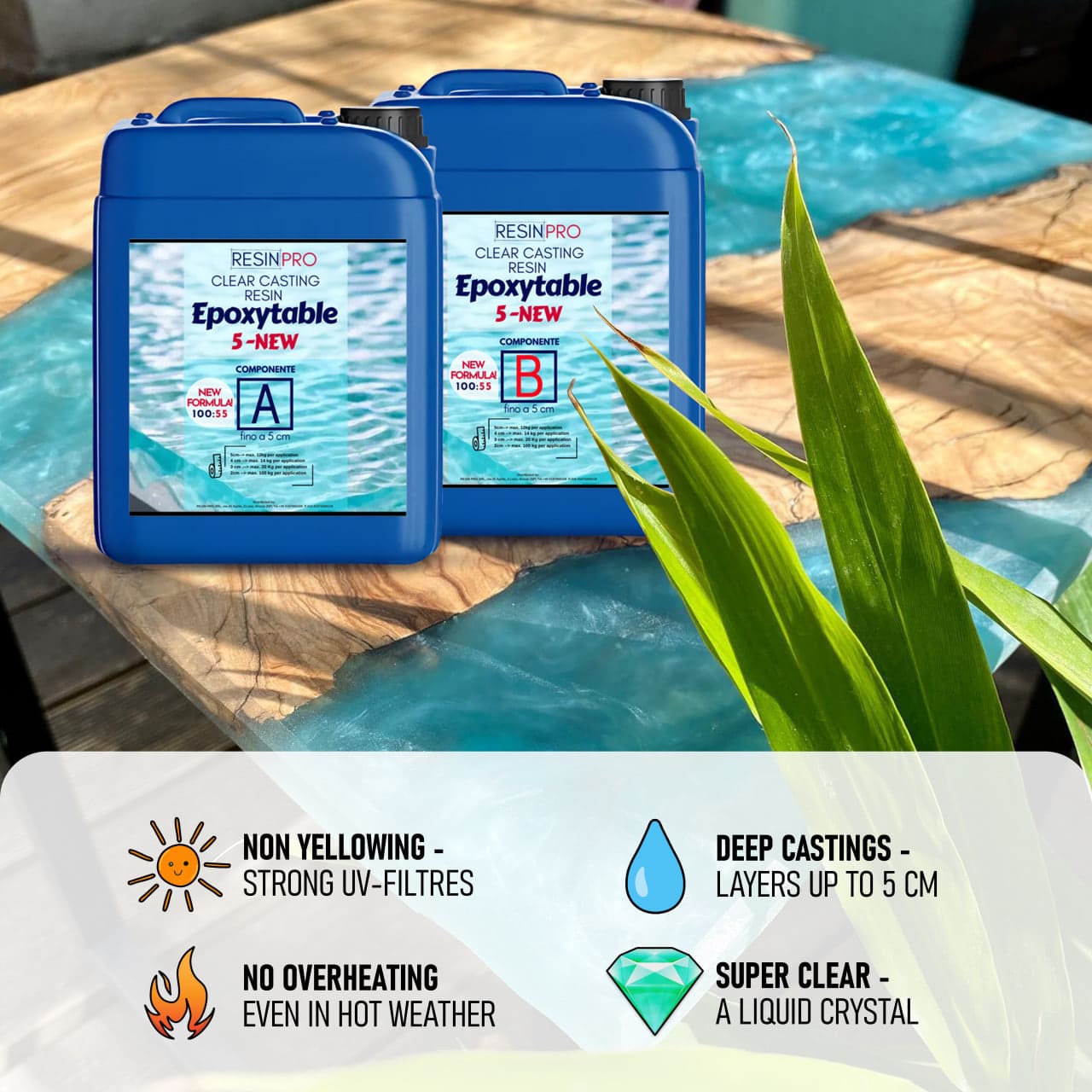
- "EpoxyTable 5-Five" – Deep Pour Epoxy Resin for Tables and Large Projects – Up to 5cmPrice range: £16.85 through £1,099.85EpoxyTable 5-Five is a deep pour epoxy resin designed for tables and large projects up to 5cm thickness, suitable for creating furniture and artistic…
- “Epoxytable 10-Ten” – Deep Pour Epoxy Resin for Tables, Up to 10cm CastingPrice range: £33.85 through £334.85“Epoxytable 10-Ten” is an epoxy resin designed for deep pours up to 10cm, commonly used for tables and artistic projects.
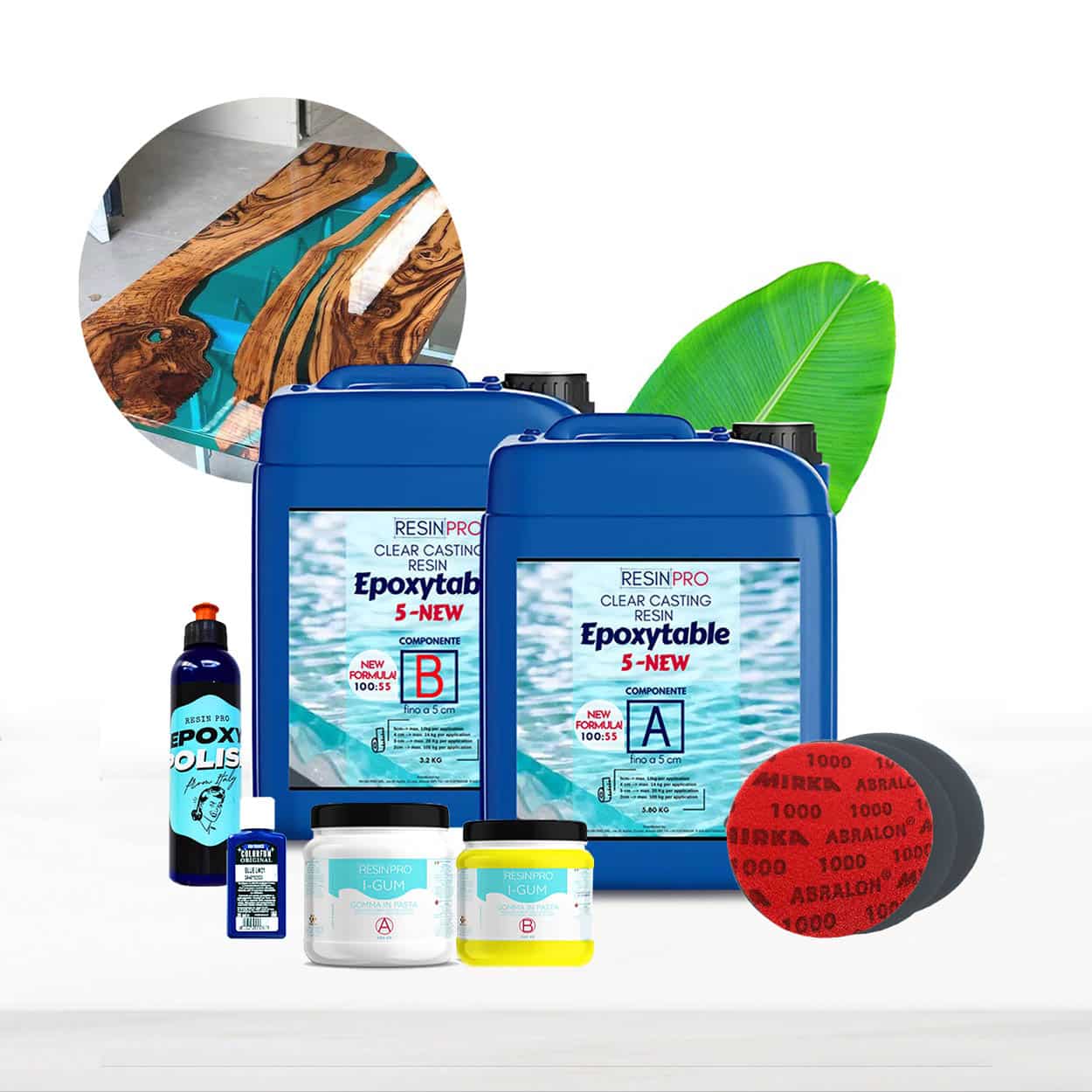 "River-Table" – Complete Kit for Creating Your First Epoxy Resin TablePrice range: £188.85 through £444.85"River-Table" kit provides materials and instructions for creating a wood and resin table, supporting this theme.
 "Trasparente" – Multipurpose Clear Epoxy Resin for Casting – Up to 2cmPrice range: £8.45 through £948.85"Trasparente" resin provides an ultra-clear, self-levelling finish with up to 2cm layer thickness suitable for various DIY and woodworking projects.
Frequently Asked Questions
How do I accurately measure the area for an epoxy resin pour on a table?
Measure the precise length, width, and average depth of each section to be filled, then calculate the total volume.
What if my table has areas with different thicknesses—how do I calculate resin?
Treat each area separately: measure and calculate the volume for each depth, then sum all areas for the total.
What should I do if I accidentally mix too much or too little resin?
Extra resin can be stored for a brief period if airtight. If you run out, mix a new batch and pour when cured to avoid seams.
Why is it important not to exceed the recommended maximum pour thickness for resin?
Exceeding the limit can cause overheating, yellowing, or haziness, and may ruin your project—always follow resin guidelines.
Should I factor in wood or decorative inserts when calculating resin volume?
Yes; subtract the volume occupied by any inserts to avoid using too much resin and achieve accurate results.
How do I convert the calculated volume into the required weight of epoxy resin?
Most resins are close to 1g/cm³, so 1 litre ≈ 1kg. Check your specific resin data sheet for the precise value if needed.