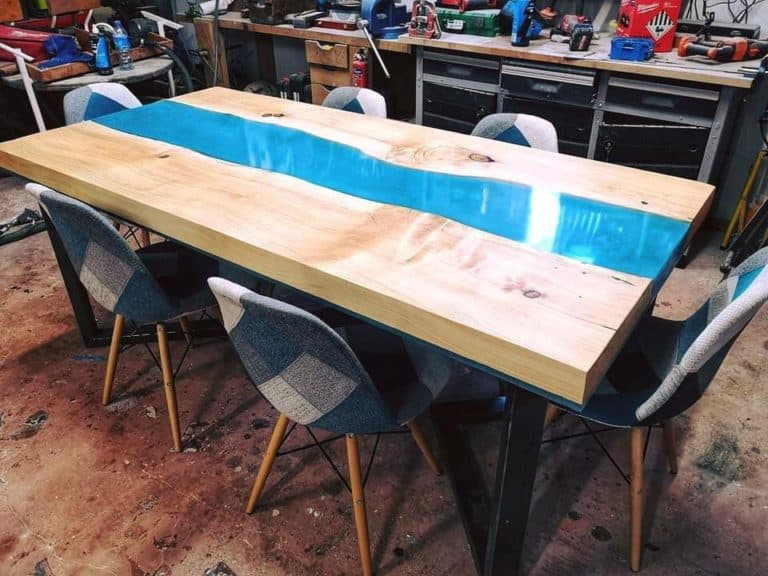
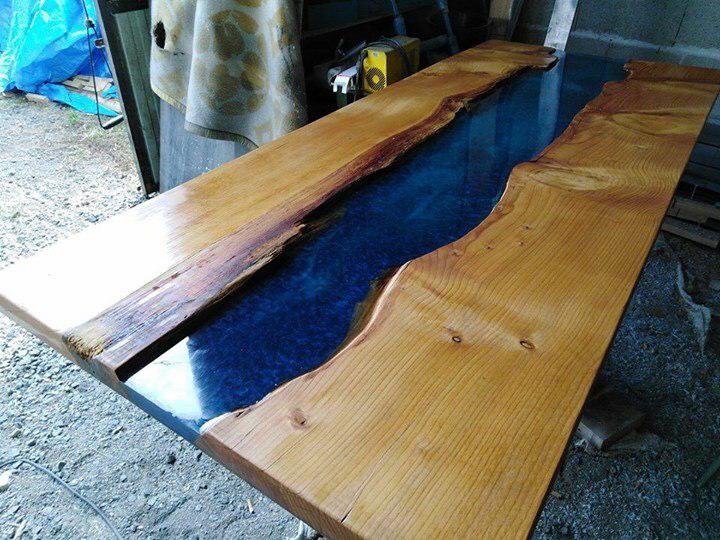
💥No. 1 Value Epoxy Resin in the UK💥
Free shipping on orders over £29.85

3 important features you must know before working with resin

Dear customer! We`d like to make sure everything goes well and you get the best results possible when working with resin. But.. Not everything depends on manufacturer’s side. Please read these instructions and you will get wonderful results.

⚖️ 1. PROPORTIONS. ⚖️


THE PROPORTIONS PRINTED ON THE TANKS, PLEASE CHECK IT BEFORE USING
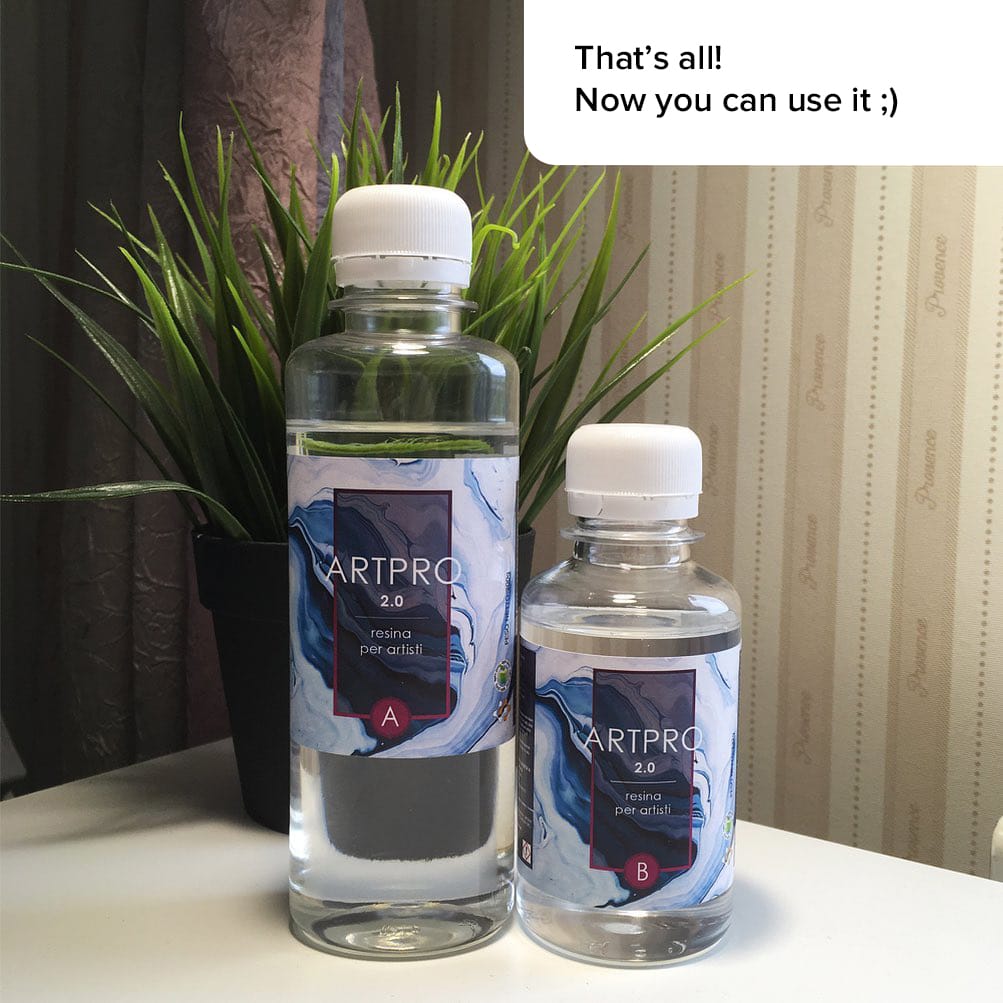
Being a two-component resin, you have 2 bottles at your disposal, one containing resin “A” and the other containing hardener “B”. You will need some electronic scales to weigh grams and a mixing container where you can combine the liquids.
How to calculate, how much hardener do you need? Take your proportions –JUST AN EXAMPLE – 100:60. Then take the weigh of component A and multiply on B, (if 100:60 – A*0.60; if 100:70 – A*0.70; if 100:87 – A*0.87).
So! If you have component A 5kg, and proportions 100:60, your calculation –
5*0.6=3kg of component B.
Please, use some electronic scales and weigh in grams to get the best results.

❄️ 2. FROZEN EPOXY. ❄️


Epoxy can become frozen under 20C.

There is no excuse that you hold your epoxy inside a warm room, the epoxy could be frozen much before, and only proper defrosting will return the lost transparency and liquidity.

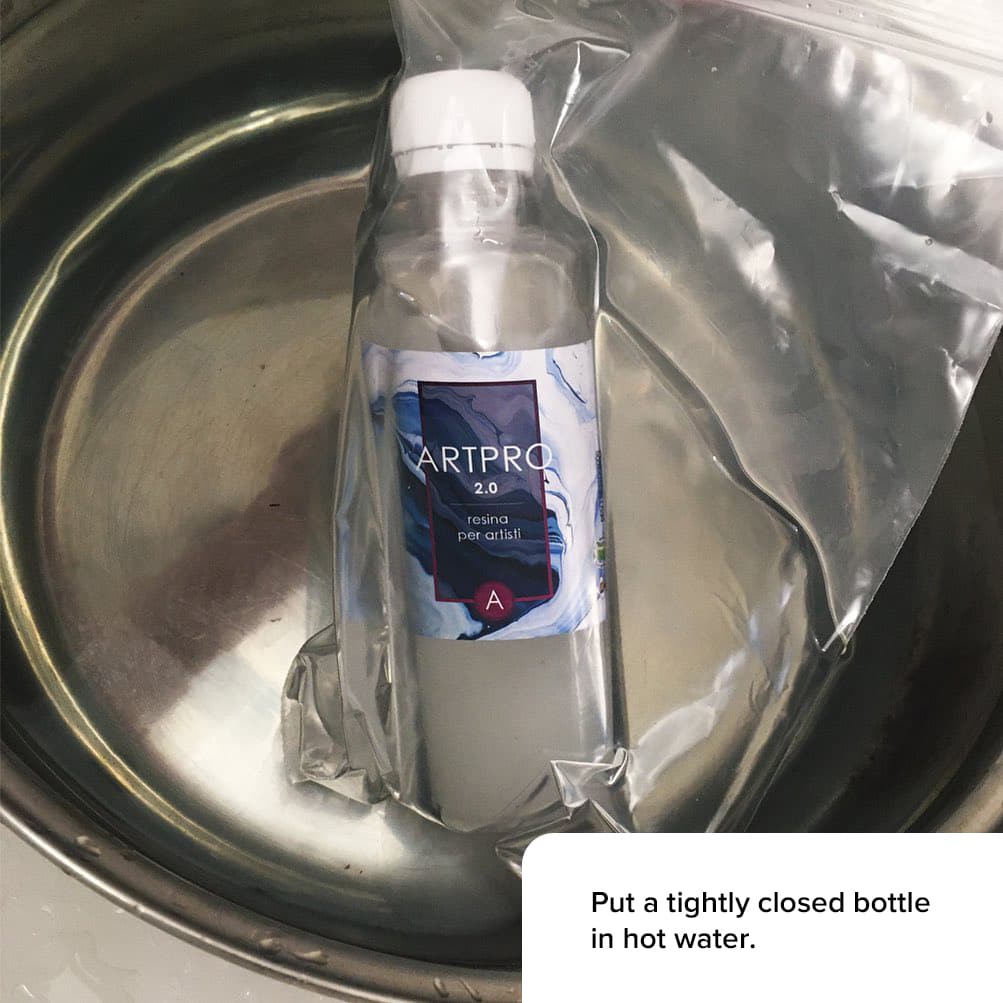
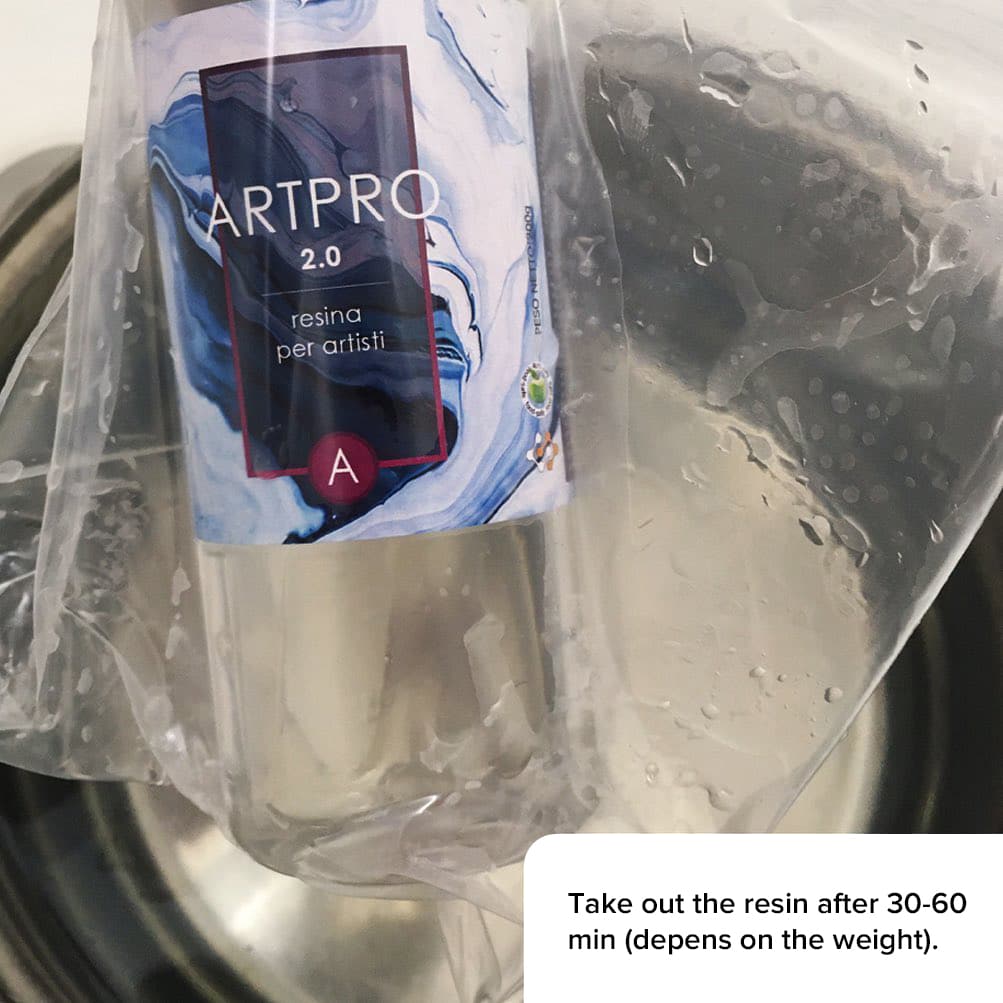
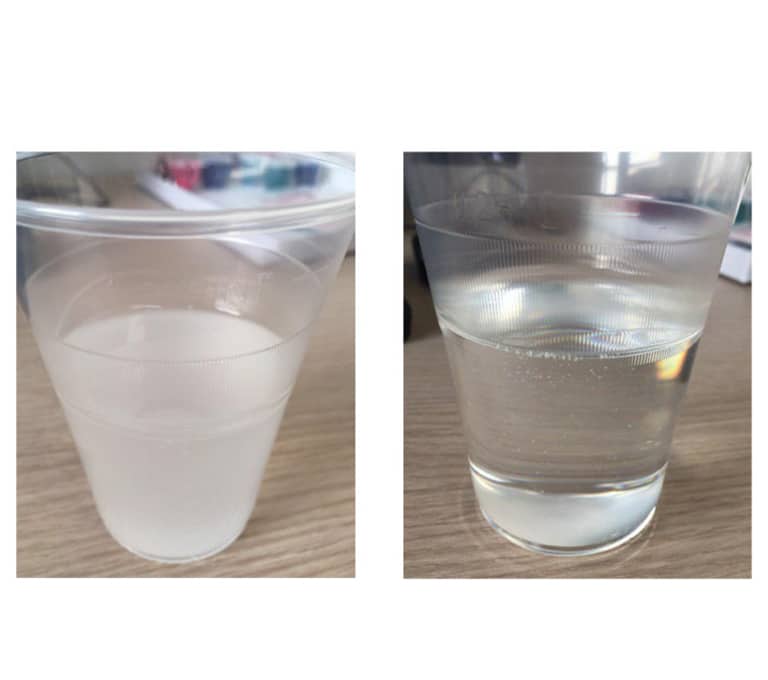
How to understand why your epoxy was frozen? The component A is murky or solid, like frozen water. Don`t worry, there is no need to dispose of your epoxy and run to leave a bad review. It`s okay. You need to do only one thing – to defrost it, warming component A to 50-70 ° C. We usually put the closed tank inside the sink with very hot water and leave it for 20-30 minutes and leave it for 20-30 minutes. The problem is next – the more epoxy inside the tank, the more difficult to warm it properly, so just repeat the procedure. If it doesn`t help, just try again, because we sold thousands of tons of the epoxy resin and every time the problem was sorted out by waiting a little bit longer in hot water (of course with the closed lid). Yes, we totally understand that it causes excessive movements, but it`s natural and it could happen with any other epoxy.

Of course, after defrosting you need to cool the component A to the room temperature before using.
🔥 3. OVERHEATING. 🔥


There are many ways to ruin your project and we listed all the known ways at this moment (If you have any other issues, please contact us.)
Let`s start!
🔥
A) Every epoxy has the limit of depth of layer you could do per one application (For example “Transparent” epoxy resin – 2cm; Epoxytable-5 and Crystal-5 – 5cm).
If you need to make a larger layer, just pour in several steps, waiting 8-10h the first time; 10-12h in the second time and 12+h the third time).
🔥
B) If one side of casting is more than 100cm long, please, create your project in layers (each layer being 1-2cm thinner than recommended) with a time interval like above –  (waiting 8-10h the first time; 10-12h the second time and 12+h in the third time).
🔥
C) If  you do a Round casting, and the required weight A+B exceeds 3kg, create your project in the same way as above (less thickness per application + longer waiting between layers). 🔥
D) Be especially careful when working with resins for large castings, when mixing a large amount of resin, do not leave the mixture for a long time in one container – pour it immediately into other smaller containers to avoid the “mass” effect: the resin begins to heat up quickly and hardens instantly with defects without the chances to change it in any way.
🔥
E) If you`re still reading, we`re definitely proud of you!
The last thing on what we`d like to pay your attention is the restriction by amount of epoxy resin per application. Yes, it`s quite difficult for understanding, but the more epoxy you use – the more chance to burn it.
What to do? Just check the label!
For example, for ICRYSTAL-5 we insistently  recommend don`t  make larger thickness depended on weight per application –
5cm –> maximum 12kg per application
4cm –> maximum 14kg per application
3cm –> maximum 20kg per application
2cm –> maximum 100kg per application
IF YOU`RE GOING TO MAKE LARGER THICKNESS, JUST WAIT 12-14h and make an additional layer, with the same rules, like above.


IF YOU MEET MORE THAN ONE EXCEPTION IN YOUR PROJECT, REDUCE THE SIZE OF YOUR APPLICATION AGAIN. Epoxy resin is a complicated technical product, but if you follow the basic rules, you will get wonderful results!
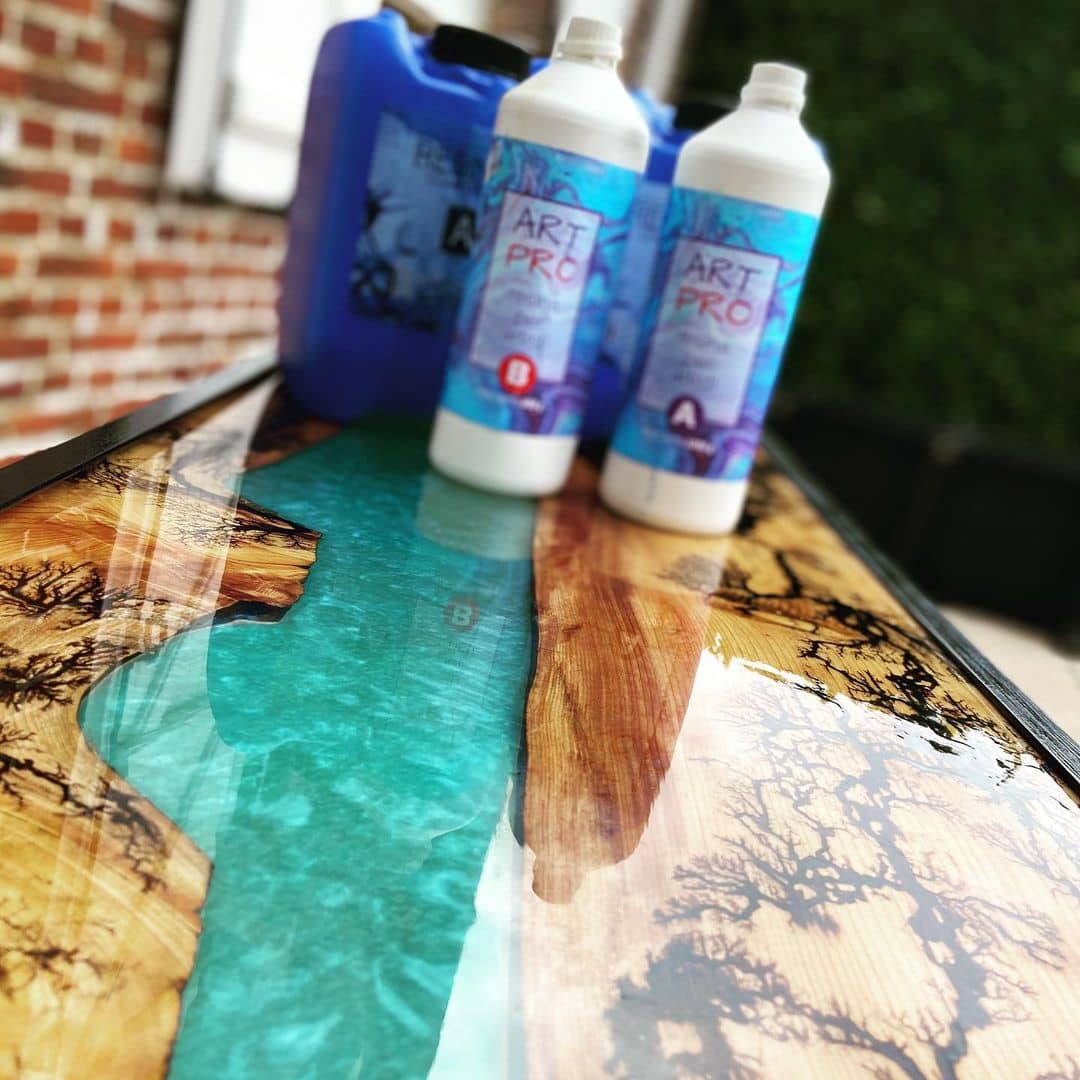

More resin = less pollution

If your work with resin is not limited to one small kit, or you are used to buying for future use, we can offer you bulk kits of resin at attractive prices: purchasing them motivates us to buy fewer small bottles, which reduces plastic consumption and makes our world cleaner.

Resins for countertops, furniture and castings up to 2 cm thick

Resins for countertops, furniture and castings up to 5 cm thick

Resins for Resin Art, coasters, trays and etc

Remember to dispose of empty plastic containers at an appropriate recycling collection points after curing the resin and hardener residues!

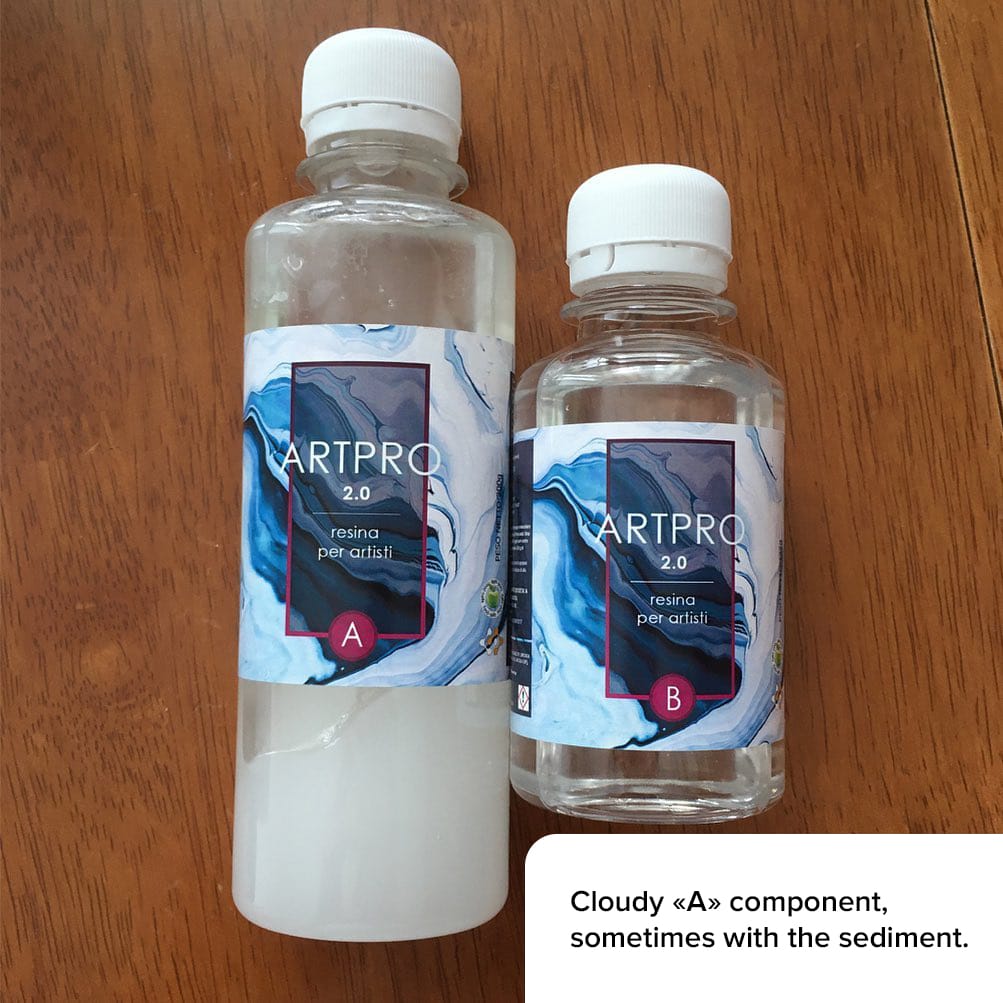
Epoxy resin is cloudy! What to do?

One day you may receive the parcel with epoxy resin, but after taking the goods out of the box, you may
be unpleasantly surprised that the resin has become «cloudy»: instead of the claimed crystal-clear
colour, you see a cloudy shade and/or white flakes in the sediment at the bottom of the bottle.

Explanation

Resins produced by different manufacturers differ in composition and properties, so they can also react
differently to environmental conditions. Since our epoxy resin is produced in Italy, in the Liguria region,
it is assumed that the resin will be stored in a suitable climate.
However, the United Kingdom is distinguished by lower temperatures in autumn, winter and spring,
therefore, during these seasons (and sometimes even in rainy and cool periods in summer), the resin, or
rather component “A”, can acquire a cloudy shade: from light, barely noticeable to saturated “milky”
with a dense sediment at the bottom or with dense clots in the thickness of the resin.

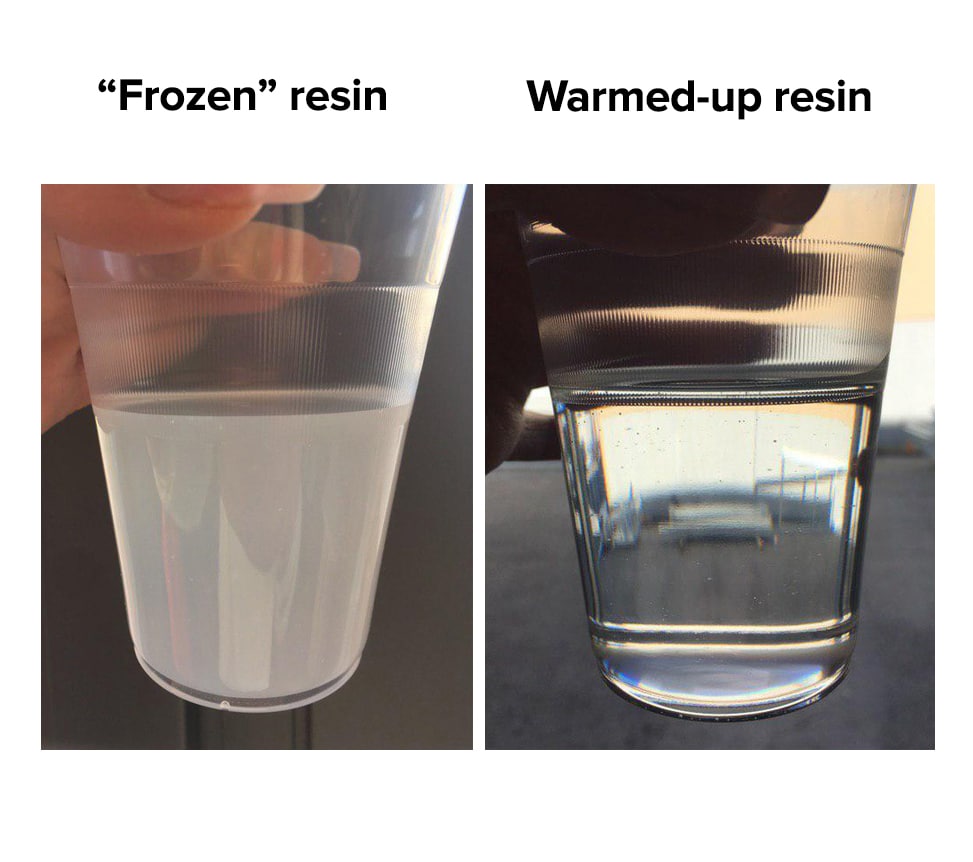
For comparison: cloudy resin (left) and clear resin (right)

Can one work with cloudy resin?

Not without fixing first! Castings made from cloudy epoxy resin can have a number of defects after
curing, and your resin makes can no longer be salvaged. The most common defect is the flexibility of the
creation.

What to do?

First of all – do not panic. Cloudy epoxy in cold weather is a normal phenomenon, it is the same natural
phenomenon as freezing of water in winter in reservoirs. But as soon as spring comes, the ice begins to
melt. Almost the same thing happens with resin, albeit with some nuances: the resin “freezes” at higher
temperatures than water (at 15-20 ° C), and for its “defrosting” temperatures higher than those
recommended for its storage are needed: 50 -70 ° C.

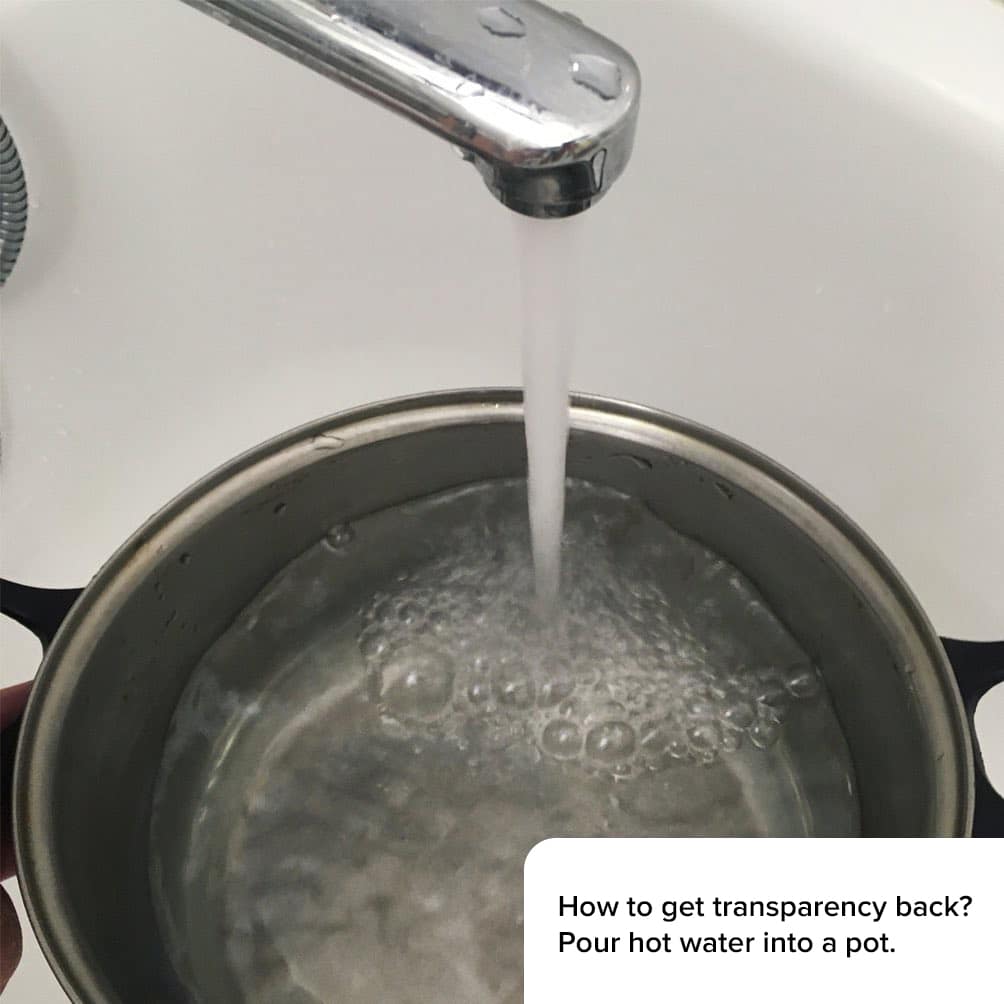
To turn the cloudy resin to its original transparency, you need to put a tightly closed bottle / canister in a
container with hot water (50-70 ° C) for 30-40 minutes until the turbidity disappears completely. This
time period is indicated for small volumes, but if you need to warm up an entire can of resin, it will take
about an hour. You can check the transparency of the resin in the cans using a flashlight. Also, in order
to eliminate the turbidity of the resin in large volumes, it will probably be necessary to change the
cooling water to hot water a couple of times.

HOWEVER: even if the resin has begun to gradually become transparent, you should not immediately
pull it out of the hot water. The resin must lie in it for some time for the “thawing” process to be
successfully completed. A perfectly clear colour is an indicator that the resin can already be used.

After such hot water procedures, the resin can be used again for its intended purpose without the risk of
getting jewelry and paintings with defects

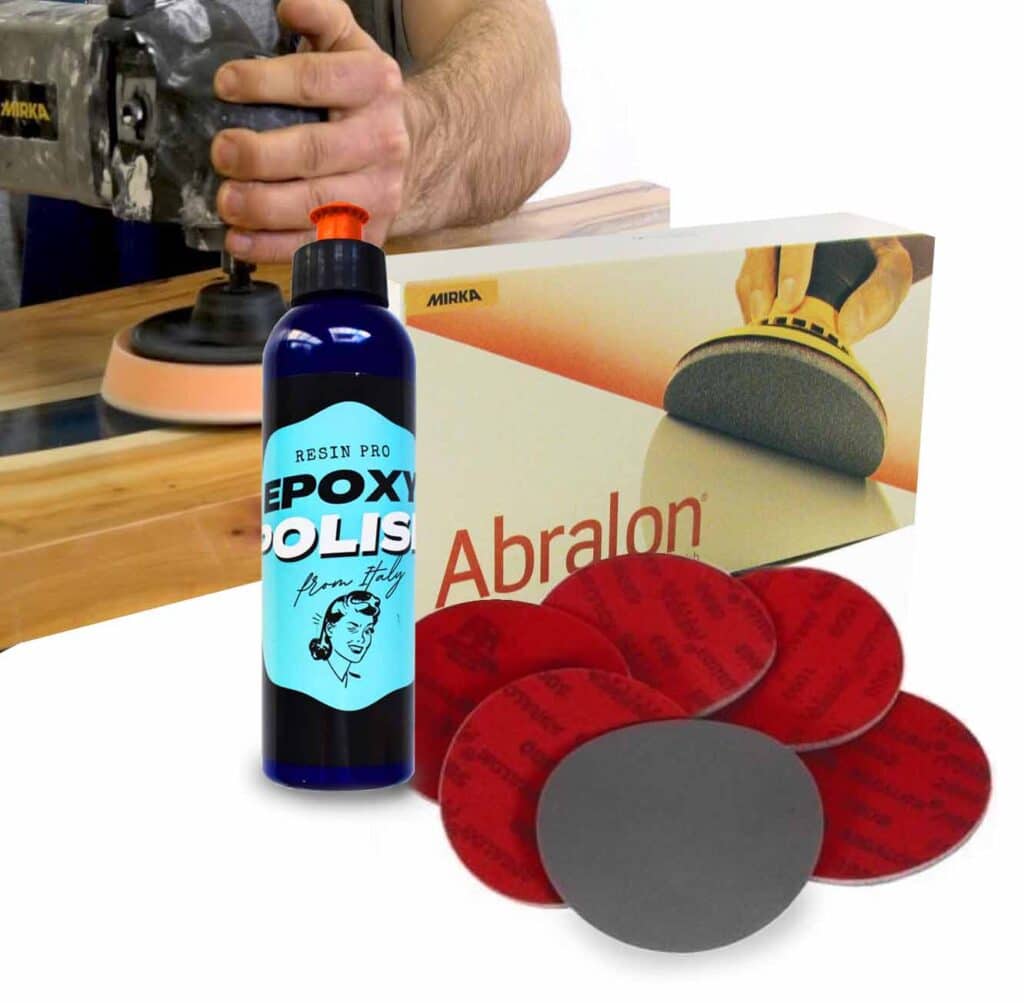
RESIN PRO POLISHING KIT INSTRUCTIONS

Polishing is definitely a fundamental step when it comes to finishing a resin surface. Although, in fact, the resin cures glossy by its nature, due to the problems arising from the humidity rate that is too high, annoying opaque halos may appear on your surface.

But don’t worry! Thanks to the RESINPRO POLISHING KIT, you will be able to finish your creations in a simple and direct way without the need for decades of experience in this field.

So here are the basic steps you will need to perform to make the most of this fantastic product.

1) PREPARATION OF THE PLAN

Start by putting the resin surface that you will have to polish under a damp cloth, to avoid sudden movements caused by the vibration of the orbital polisher. We also recommend that you keep a damp cloth at hand for rinsing between one grain and another.

2) POLISHING

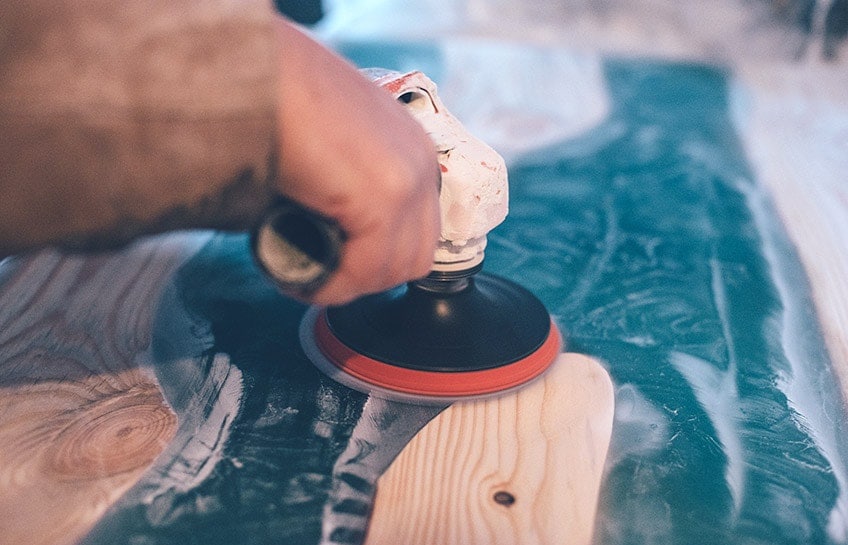
Starting with the lowest grain, place the disc on the polisher attachment and start working on your surface. It is very important to keep the polisher always in motion and try not to dwell on the same spot for more than 2-3 seconds. Move in a uniform and geometric way so as to cover all points of the surface without leaving any uncovered. Once you have finished the first step, wipe the damp cloth slightly wet with ethyl alcohol – the very common pink alcohol – on your surface before moving on to the next grain. Once you have reached the last grain (4000), it will be very important to wet the surface with a little water before using the polisher: in this way, all the marks left by the previous discs will be perfectly eliminated. Once the 4000 grit has also been used up, dry your surface and get ready to apply the Polish.

3) POLISH APPLICATION

After going through all the grits, your piece will already look shiny but not perfect yet. The time has come to finish everything by applying EPOXYPOLISH RESINPRO, the final product that will allow you to obtain a bright and lasting polish. Pour a little Epoxypolish on the appropriate pad and mount it on the orbital polisher and then start, always following a geometric and uniform movement, to pass it on your resin surface. Once the top has been polished, remove the excess polish using another pad or, if you do not have it available, a woolen cloth.

Now your table will shine perfectly and is ready to be used!

Planning and creation of large resin tables – main issues, guidelines and practical advice

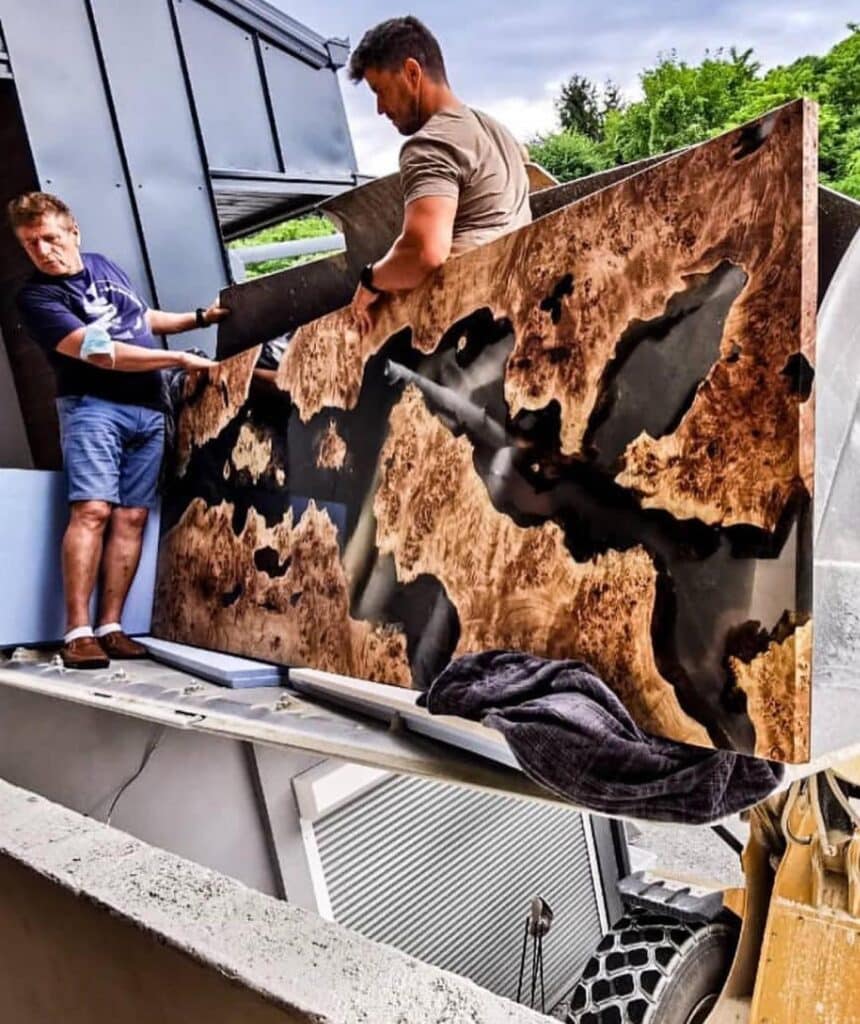
Every time you try your hand at artistic creations with epoxy resin and wood, you increasingly find yourself having to replicate some of the working techniques in a “big” way.

How to build a large table with wood and epoxy resin? Here are the main problems, guidelines and practical advice.

As long as you create small objects and limited surfaces, no problem; but as soon as you try to create a truly large structure, the good results of the small “test” sample disappear. In these pages we will show the main strategies to obtain the perfect creations, even in style. If you want to see the BASIC information on how to work wood and resin, you can visit the website www.resinpro.eu/BLOG, where you will find several articles on “How to build a wood and resin table” – “How to use epoxy resin? “.

If you are trying your hand for the first time in an application of this type, let’s start with the golden rule
NEVER HURRY.

The processing of the resin, although it may seem easy, hides several pitfalls (especially for beginners). With the different educational articles that you can find on www.resinpro.eu/BLOG, you can learn the dosing methods, the preparation methods and how to handle epoxy systems. Furthermore, if it’s your “first table”, we recommend you try creating a smaller version first, to get familiar with the technique (for example a shelf). This way you will avoid ruining precious tables of fine wood.

Planning and creation of large resin tables - main issues, guidelines and practical advice

Here are the 4 Main Problems:

1. The increase in size does NOT allow you to devote the usual attention and care to all parts.
2. The increase in resin mass casting, leads to an acceleration of catalysis and development of high temperatures. This can lead to the thermal stress of the resin, which could crack or deform.
3. The increase in the catalyst temperature corresponds to an increase in the evaporation of water inside the wood, and therefore, an increase of the micro-bubbles that remain trapped in the resin.
4. The creation of a suitable formwork requires careful planning.

Let’s start from the last point (formwork and handling):

For large tables, a formwork must be used. A free work area also must be chosen (so that you can work around the formwork), and must be one that can be occupied for at least 2-3 days (in fact this is the preparation time for a standard table). The flatness must be checked before pouring the resin, in order to avoid that the table appears asymmetrical.

Planning and creation of large resin tables - main issues, guidelines and practical adviceChipboard formwork

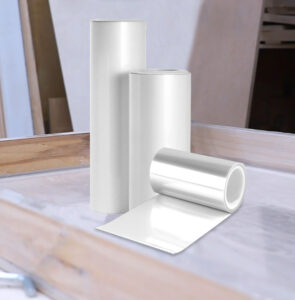
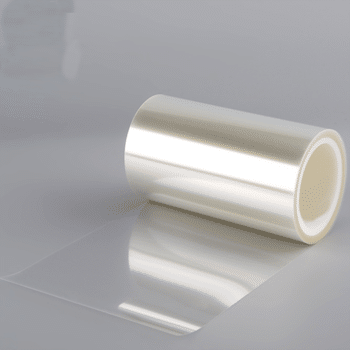
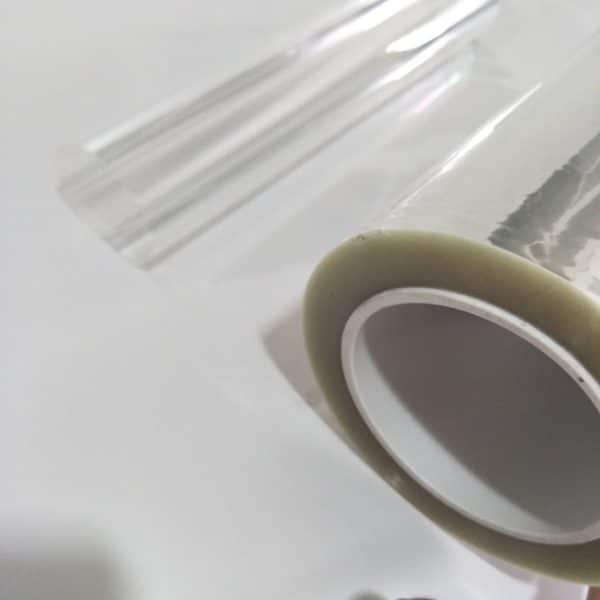
If you want to build a large table, the cheapest (and above all, modular) solution, is to use a simple chipboard formwork (or any other types of wood) protected only in the points in contact with the resin, with the specific “SHINY SHIELD” film, in order to have a non-stick surface for the resin (which would otherwise stick to the wood).

  •  For the bottom: after cleaning the surface (so that it is perfectly smooth), carefully apply the SHINY SHIELD film, applying light pressure with a spatula to prevent air bubbles or irregularities.
  • For the edges: chipboard boards attached using I-GUM silicone paste (or even hot glue), then cover them with a continuous layer of SHINY SHIELD film (the less cuts / joints you make in the film, the less likely you will have leaks).
  • Then place the boards on the surface (already covered by the film), and pass all the joints with the I-GUM paste (passing it with a finger, you will give it a rounded shape that will become the lower edge of the table), in this way the resin cannot stick to anything. Finally, seal all the joints with silicone paste (I-GUM – Rubber paste) for greater safety. This way you create an economic formwork (chipboard + silicone) that you can then cut and “modify”, according to the size of the table.

Once the resin is solidified, you can simply dismantle the formwork and extract the table.
The SHINY SHIELD film is reusable and also resists any thermal spikes of the resin (up to over 100° C) so if well designed, your formwork can be reused!

Planning and creation of large resin tables - main issues, guidelines and practical adviceFor point 1 (impossibility to take care of all the details at the same time) the only possible solution is to prepare the whole procedure in an organic way so that, at the time of casting, you only have to concentrate on the aesthetics of the product.
Here are the most common setbacks that happen immediately after casting (and that make us waste time and concentration):

1. The formwork is not sealed and leaks resin, which drips to the ground. To avoid this problem, just put the wood in the formwork FIRST, and then make a test casting of a few mm thickness, on the edges and joints (critical points). This way we will immediately know if the formwork is leaking and, in case, the possibility to eliminate any leaks with the I-GUM silicone paste.

2. Once the casting is done, we realize that there are impurities. In order to avoid having to “hunt” splinters, hair or crumbs, before casting, the formwork and the wood and all the tools must be cleaned with an electrostatic cloth (like swiffer). Eventually filter the resin through a strainer (or even nylon socks!)

3. Dust particles or insects settle on the surface. In this case it is good to clean the work area with a vacuum cleaner and then spread a sheet of transparent film to protect the surface (such as the one used to protect furniture when repainting the walls)

In this way you will be able to focus only on what is important, which means the aesthetic rendering of the casting!

Difficulty in managing large thicknesses (overheating, multiple casting, air bubbles)

Planning and creation of large resin tables - main issues, guidelines and practical adviceAs we have seen from previous articles, the overheating of the resin, the acceleration of catalysis and the consequent incorporation of micro-bubbles, are unfortunately a chemical phenomena that derive from the so-called mass effect.
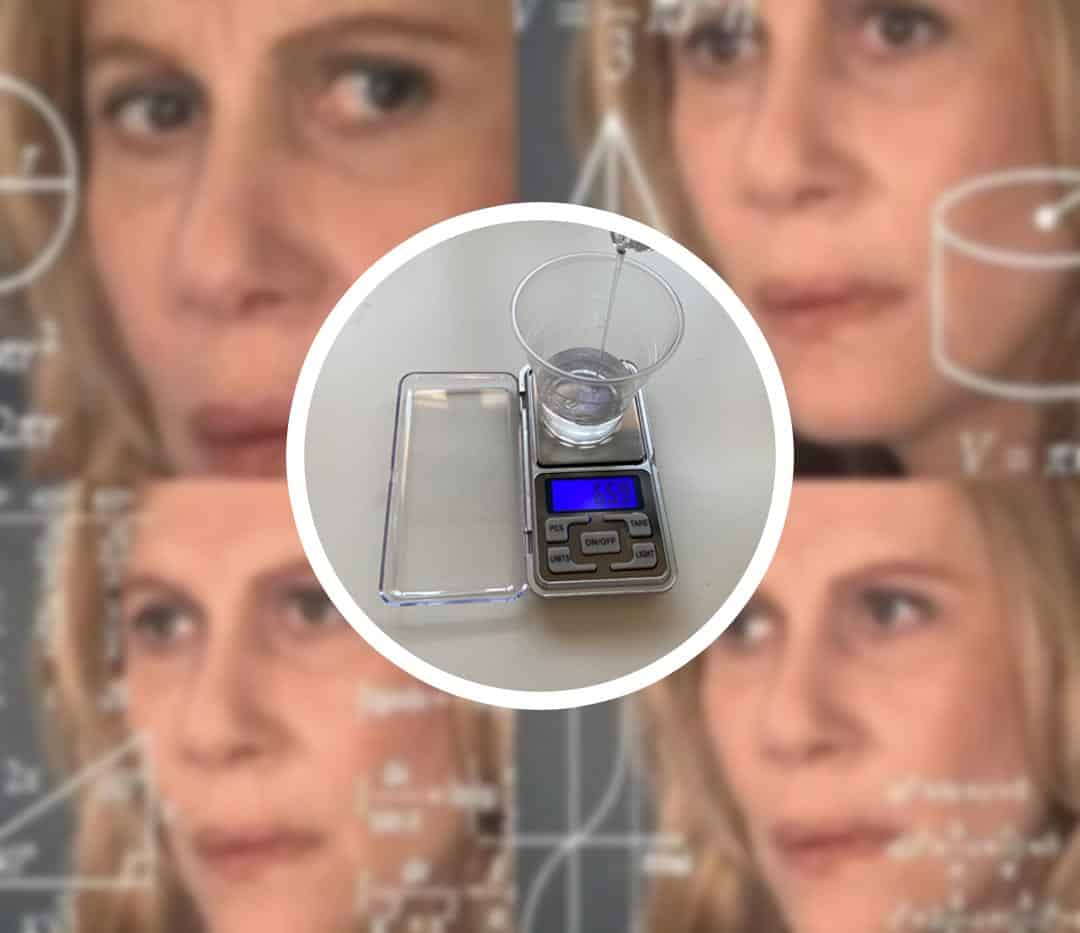
How to make a large table in wood and epoxy resin avoiding this “mass effect”?
You need to know that, the greater the quantity of resin casted (therefore its thickness), the greater the temperature developed. For example, by using the classic resins on the market, a SINGLE casting of 4 cm thick would lead to the overheating of the resin by more than 100°C, which would deform the formwork and would “boil” the resin itself. Basically … a table to throw away!!!
The solution (so far), is to make castings of a maximum of 2 cm in thickness, a few hours apart. The disadvantage (in addition to the extended processing times) is that for each casting, we must make sure that there are no impurities or bubbles.
If, on the other hand, you purchased EPOXYTABLE resin, you can apply all the resin in ONE SINGLE CASTING OF 6 CM, thanks to the innovative formula, with high UV resistance and mechanical resistance.

HOW TO CALCULATE THE QUANTITY OF A AND B IN EPOXY RESINS

One of the most frequently encountered difficulties when it comes to Epoxy Resin is the accuracy needed in calculating the proportions between the two components. Although the mathematical proportion is somewhat elementary, it is very easy to fall into confusion and get the relationship wrong, risking compromising the final result.
Here is a small guide to correctly calculate the ratio between A and B.

STARTER KIT PRO with Silicone rubber for casting

1 – THE EMPLOYMENT RATIO

Don’t be frightened by this term! The use ratio is simply the ratio that defines the quantity of product A and product B needed to catalyze the product well. Being two-component it is essential that the Resin and Hardener are dosed with extreme precision. To simplify things, we can therefore define the use ratio as the amount of A and B to be used to harden our compound.

2 – CALCULATE THE EMPLOYMENT RATIO GIVEN A CERTAIN QUANTITY OF A

It is very likely that, especially the first few times, you will be required to do some small tests to understand how the resin works and whether the purchased product is really for you. When you do small experiments or small artifacts, you may not already have an established quantity of resin but you proceed in a fairly random way. How then do you calculate the quantity of B to be mixed with x quantity of A?

As you can see, on the label of each product there is a mathematical proportion: 100: X (where X corresponds to the amount of hardener that changes depending on the type of product).
100” indicates instead the universal quantity of Resin A that you will choose to use, therefore at 100 (grams, kilos etc.) of A, it will be necessary to mix X (grams, kilos, etc.) of B.

Ex. : Transparent Epoxy Resin, 100: 60
Epoxy resin Epoxy5-five, 100: 55

If your resin has a ratio of 100: 55, it will mean that, for example, to 100 grams of A, 66 grams of B or, more simply, 55% will be added.
So far, nothing simpler but how to calculate the quantity of B when A does not correspond to 100?
Also in this case, we will have to rely on a very simple mathematical operation that will serve to find the coefficient with which you will multiply the quantity of A.

A (Resin) = 100; B (Hardener) = 66
66/100 = 0,66 – COEFFICIENT OF CALCULATION
By multiplying any amount of A by this coefficient, you will get the grams of B to add to your compound.

Clearly, by changing the employment ratio, the coefficient will also change

Ex: Ratio A 100: B 55; Coefficient = 55/100 = 0.55
Ratio A 100: B 60; Coefficient = 60/100 = 0.60

Now let’s see a more concrete example:
I poured 32 g of resin (ratio 100: 66), how many grams of B should I add?

32 g of A X 0.66 = 21.12 g of B.

To calculate the quantity of B, it will therefore only be necessary to multiply the grams of A by the figure of the ratio of use positioned on the right, preceded by a 0.

HOW TO CALCULATE THE QUANTITY OF A AND B IN EPOXY RESINS

3 – CALCULATE THE USE RATIO GIVEN A DETERMINED TOTAL QUANTITY OF RESIN

If you choose to continue your adventure in the world of resin, it will certainly happen that, after having made a certain calculation, you will have obtained the total amount of hardest resin to use.
This time you will not start from a certain quantity of A but, on the contrary, from the total quantity that you will have to go to “separate” to respect the correct employment ratio.
If you need to use, for example, a total of 58.40 kg of a compound with an application ratio of 100: 66, here is the calculation you will have to do initially:

Total 58.40 kg / 1.66 = A. A = 35.18 Kg.

To calculate A, given a total quantity of compound, it will therefore only be necessary to divide the total quantity by the figure of the use ratio positioned on the right, preceded by a 1.
At this point, to calculate the amount of B, you just have to perform the operation already listed in point 2.

CALCULATION EXAMPLES FOR SOME TYPES OF RESIN PRO RESINS STARTING FROM A TOTAL QUANTITY OF COMPOUND (A + B) EQUAL TO 50 KG.

Transparent resin cast up to 2 cm – RATIO 100: 60
50 Kg / 1.60 = 31.25 Kg of A
31.25 Kg (A) X 0.60 = 18.75 Kg of B

Epoxy5-five resin cast up to 5 cm – RATIO 100: 50
50 Kg / 1.50 = 33.33 Kg of A
33.33 Kg (A) X 0.50 = 16.66 Kg of B

Art Pro resin – RATIO 100: 66
50 Kg / 1.66 = 30.12 Kg of A
30.12 Kg (A) X 0.66 = 19.87 Kg of B

Art Pro Deluxe resin – RATIO 100: 70
50 Kg / 1.70 = 29.41 Kg of A
29.41 Kg (A) X 0.70 = 20.58 Kg of B

EpoxyFood resin – RATIO 100: 55
50 Kg / 1.55 = 32.25 Kg of A
32.25 Kg (A) X 0.55 = 17.74 Kg of B

Top Pro Heat Resistant resin – RATIO 100: 80
50 Kg / 1.80 = 27.77 Kg of A
27.77 Kg (A) X 0.80 = 22.22 Kg of B

Epoxy Table resin casts up to 10 cm – RATIO 100: 25
50 Kg / 1.25 = 40 Kg of A
40 Kg (A) X 0.25 = 10 Kg of B

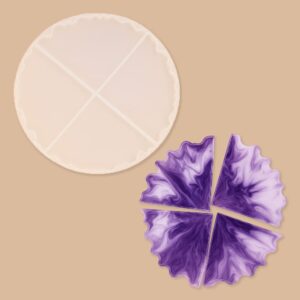
Epoxy resin coasters: mold, resin and most suitable colors

[vc_row][vc_column][vc_column_text text_larger=”no”]Do you want to ride the latest trend and have coasters perfectly in tune with the environment around you?

Here’s how to make custom resin coasters for any occasion!

They are easy to customize even for special events (weddings, product launches, …)

Here’s what you’ll need to create your perfect coasters:[/vc_column_text][/vc_column][/vc_row][vc_row][vc_column]

[/vc_column][/vc_row][vc_row][vc_column][vc_column_text text_larger=”no”]Optional:

Small silicone cup

Weight scale

Stick to mix

Thermal gun

Toothpick

Mat[/vc_column_text][/vc_column][/vc_row][vc_row][vc_column][vc_column_text text_larger=”no”]+ Stick to mix & Toothpick

DIE

You can buy a ready-made mold or build your own that will have a UNIQUE shape!

To create your own mould using our iGum paste, start by mixing the 2 components of the iGum paste. Knead until the color becomes uniform (about a minute). Create a tubular shape to adhere to the ShinyShield film (we do not recommend nylon or kitchen film because they create unsightly creases) to create the perimeter of the coaster.

REMEMBER: the more irregular it will be, the more unique it will be!

TIPS: You can also insert a sheet under the film to trace the shape.

ATTENTION: this step must be done quickly because the paste hardens in about 20 * minutes.

GEODE

This technique is very simple, but it has a wow effect that you will only see by flipping the coaster over.

(no title)

  1. Divide the Art Pro (after weighing and mixing it) into as many small glasses as there are colors you want to use plus a larger transparent one (about half of the prepared resin) and wait a few minutes for any bubbles to rise to the surface.
  2. Pour the resin into the mold as close as possible to avoid creating bubbles and following this order:

– a color (generally the darkest) in the outermost perimeter of the mold;

– transparent resin in the center up to the external color;

– second color in the center;

– transparent resin in the center.

  1. Continue to alternate color and transparent resin until the colors run out.
  2. Finally add the glitter or read all the way for a secret. ?

FLUIDPAINT

(no title)

This technique is best suited to coat damaged or refurbished coasters.

Put all the colors chosen inside the same glass.

Turn the glass inside the coaster mold and gradually release the color.

If necessary, help yourself with a stick or hairdryer to create the design you want

For an effortless wow effect, use Resi-Blast or Magic Drops Small.


FLOWER

Pour the transparent resin inside the mold.

Alternate concentric circles of the chosen colors (you can help yourself with a pipette).

With a toothpick or stick, pull the color from the outside towards the center, cleaning it between one petal and the other.

If you want a more pointed petal rather than rounded, do the exact opposite from the center outwards in the middle of the previously created petals. Otherwise, skip this step.

With a hairdryer or heat gun, heat the surface for a few seconds, then move the color of the petals with the air from the outside to the inside.

Finally pour in the galaxy glitter.

(no title)

If necessary, quickly pass a flame to burst the bubbles.

Wait for drying, unmold and finish the edges with sandpaper. Finally, color the edges with liquid bronze available in Gold, Silver, Champagne and Pink.

(no title)


BONUS – The extra tips

  • The coasters are easily customizable both in color and with numbers, phrases, badges or logos. You can make double sided coasters by making 2 pours. In this way they will have a personalized side for special events and another for a more general use and adaptable to any type of occasion.


  • To create the crystallized part of the geode, you can replace the central glitter with a mixture of coarse cooking salt and UV resin previously cured.

* Times may vary based on environmental conditions.[/vc_column_text][/vc_column][/vc_row]

How to Mould and Make your own Resin Handles for Resin Trays. ‘Pure Mold’ Review.

In today’s video you will see how to easily make moulds / molds of handles and jars. The handle mould can be filled with epoxy resin to create matching handles for your resin projects or for anywhere else for that matter and the jar mould is perfect for making jars for loose pigment powders or glitters.

This video is a review of Resin Pro’s Pure Mold Liquid Silicone Rubber and although the items in the video were given to me, my review is completely unbiased. Resin Pro have MANY different resins to suit any project and their range of pigments, moulds and much more is well worth a look.

They ship all over Europe, the shipping is fast and if you spend over £60 it is free.

If you would like to see the Tray tutorial where I used today’s handles please click the link below. https://youtu.be/lQNnENn2668

HOW TO RESTORE A WOODEN PIECE OF FURNITURE RUINED BY TIME AND NEGLECT WITH EPOXY RESIN AND A FEW EXTRA EFFORT

Through all this section, we could show you how epoxy resin can be used in a wide variety of sectors: in the artistic, building and industrial fields, but also in the restoration of antique wooden furniture.

We want to highlight that this procedure is for those who are familiar with epoxy resin because, although it is easy to apply, involves the use of a unique and supposedly valuable wooden piece.
We therefore recommend not to improvise and gain experience before proceeding, perhaps working alongside a furniture craftsman or carpenters specialized in processing fine woods.


There are several reasons why a wooden piece of furniture may be damaged:

  • Xylophagous insects, such as woodworms;
  • Fungus;
  • Aggressive chemicals in the air;
  • Exposure to sunlight and ultraviolet light;
  • Temperature and moisture not respecting the optimum level of 22 °C [71,6 F] and 58/60%;
  • Repairs or restorations with unproper materials.


One of the best resins to restore antique wooden furniture, giving a glossy effect and strengthening the surface, is Resipro Trasparent Resin, a two-component product to be mixed in the right proportions according to the instructions on the package. It is also used for artistic creations, tables and surfaces, modelling, artistic floorings, fibreglass repairs, outdoor protective coatings. Therefore, if a piece of furniture is damaged beyond repair, you can always be creative and renovate it with transparent or coloured epoxy resin castings, even up to 3 cm [1,18”] thickness.

For embeddings, proceed with the casting to its liquid stage, being careful to make it penetrate into the cracks without letting it escape. To avoid this inconvenience, you can use clay or silicone rubber, which is easy to remove without staining.


During the gel stage, epoxy resin has a gluey consistency, it is no longer workable and you must let it dry for 6 to 24 hours.

Once solidified, it can be sanded or dry moulded.

Join us in the next episodes to discover another brand-new product, created for this kind of interventions in contact with wood: Epoxywood!


Bestseller for artistic and jewellery creations, restoration or surface coating (wood, concrete, ceramic, canvas, fibreglass) and modelling! Ideal to create table tops, souvenirs, a protective layer on printed images (photographs, canvases, paintings), design furniture, decorative and design elements through mounting techniques.


http://resin-pro.co.uk/product/transparent-epoxy-resin-kg-8/

HOW TO MAKE A RESIN AND WOOD RIVER TABLE AND COUNTERTOP (LIVE EDGE)

HOW TO MAKE A RESIN AND WOOD RIVER TABLE AND COUNTERTOP (LIVE EDGE)

Are you looking for the materials and the instructions to create your wood and resin table?
In this article, you will discover the step-by-step procedure and tips to avoid mistakes and get wonderful result!

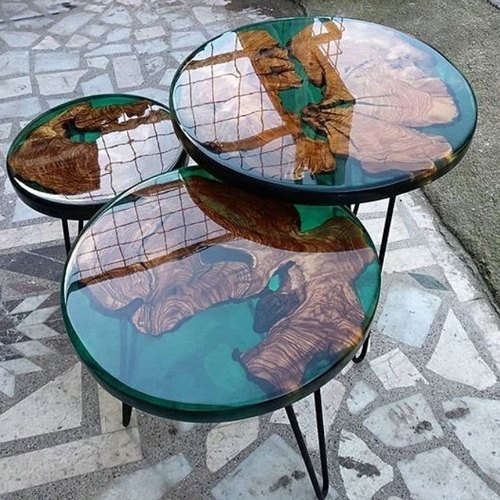
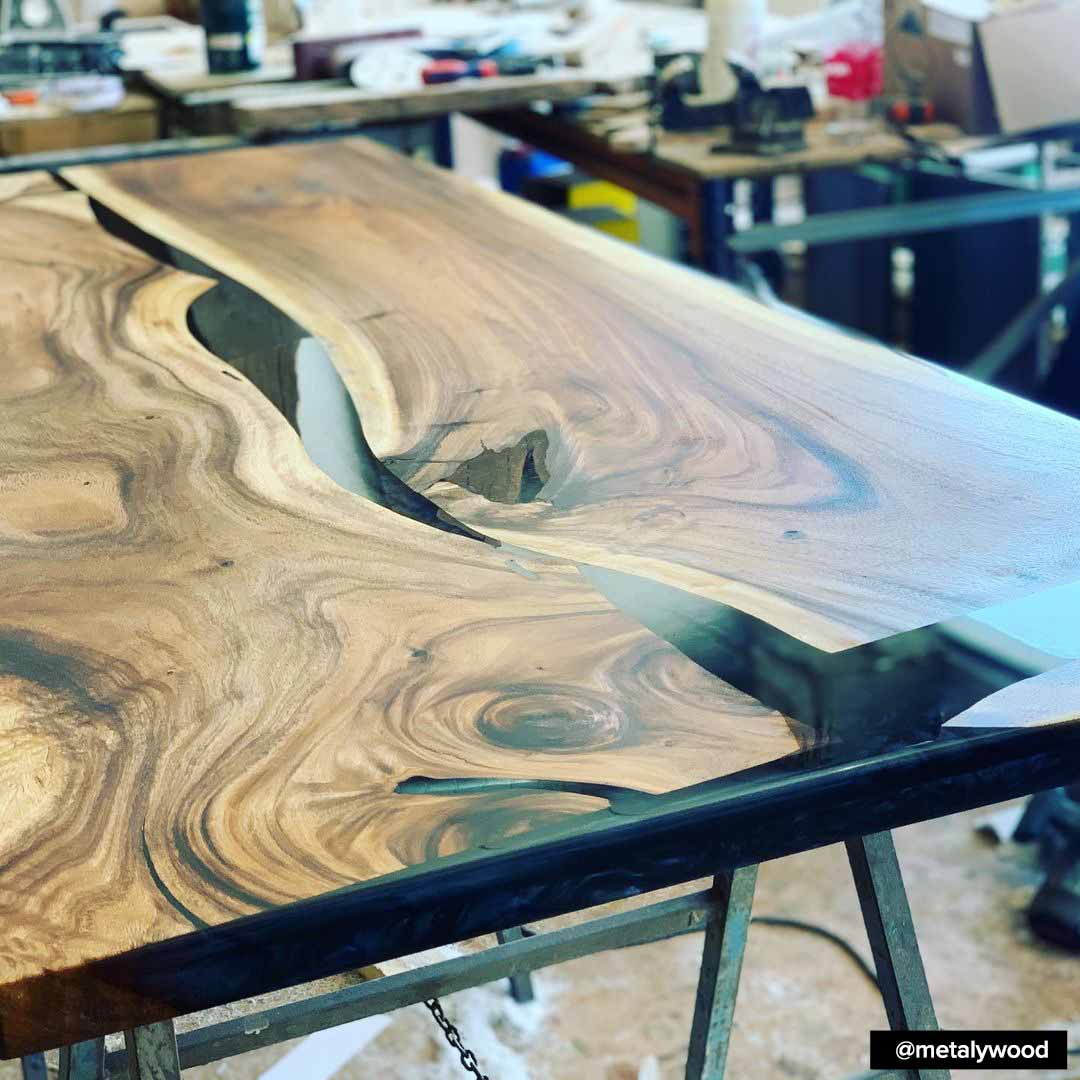
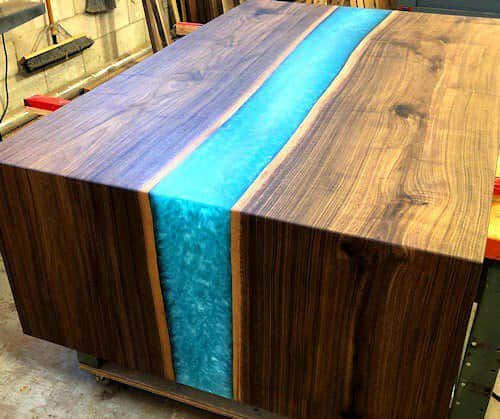
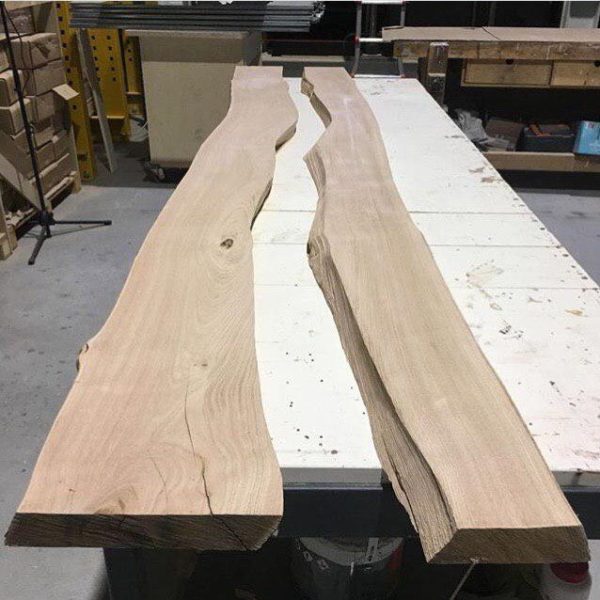
Let’s start from the beginning: what exactly is a resin and wood “river ” table?  River tables are wooden tables with a strip of coloured or crystal clear epoxy resin in the centre.
The edges instead are made of rough wooden planks and are therefore irregular. This is what renders them beautiful!
These resin and wood tables are often very expensive in store, but luckily you can easily create them yourself with our products!

What do you need to create a Wood and Resin Table or Countertop?

  • A rough wooden plank (i.e. a “slab” of tree, planed and at least 2-3 cm [0,78”-1,18”] thick);
  • Shiny Shield” release film;
  • RESINPRO Crystal clear epoxy resin;
  • Coloured pigments (optional);
  • Two buckets for mixing;
  • A disposable brush;
  • Sandpaper;
  • Polishing kit and a polishing cloth;
  • Heat gun

Epoxy resin and wood table: here are the steps.

Step 1: Choose the right wood!

This step is the easiest, but it takes time…

You have endless choices when picking the type of wood to create a “river” table. From solid and regular to sinuous with many knots to a very narrow piece of wood.
Any defects or irregularities will be filled with Transparent Crystal Clear Epoxy resin! You can find these “slabs” of tree from any carpenter or wood dealer!

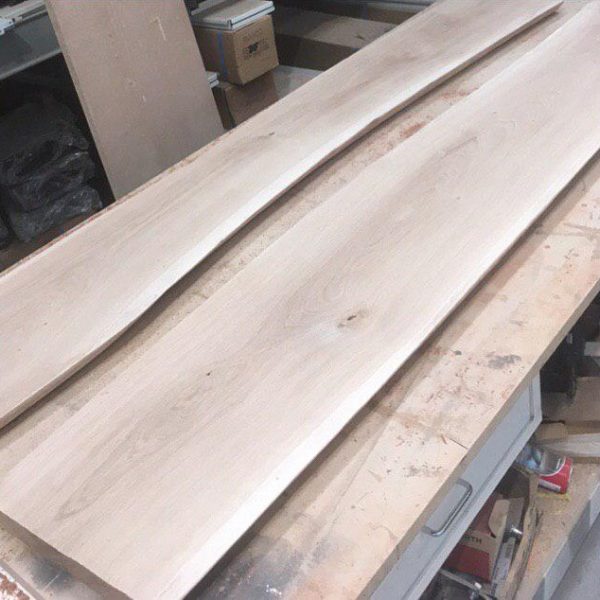
If you have chosen the wood for your river table, it is time to prepare the piece. As a general rule, a slab of the trunk is then cut in half and the two pieces are separated creating a hole in the middle which will be filled with epoxy resin. This creates the “river”. Often the edges of the wood have to be cut correctly to achieve the right dimensions.
If you want, you can remove irregularities with a sander. You can remove (or keep) the bark as well: depends on the style! Take your time to do it for a perfect final result. Of course, the wood has to be totally dried.

Step 2: Create a mould for Epoxy Resin

Now it is time to create a mould, where the pieces of wood will be positioned and crystal clear epoxy resin will be poured.
The simplest thing to do is to build a laminated chipboard container. It is easy to saw it and is available in larger sizes. If you don’t have the tools, ask a carpenter!

Afterwards, coat the inner surface with the easy-to-apply SHINY SHILED release film, which leaves the surface smooth and polished and does not let the resin stick.
(Here is the link to learn more:  http://resin-pro.co.uk/product/release-film-glossy-shiny-shield-32cm-to-create-the-table/)

Next, seal the joints with silicone rubber or sealant, then remove the excesses.

HOW TO MAKE A RIVEL LIKE TABLE WITH RESIN AND WOOD (LIVE EDGE or River Table)HOW TO MAKE A RIVEL LIKE TABLE WITH RESIN AND WOOD (LIVE EDGE or River Table)

Step 3: Wood preparation

Before carrying out the casting on the river table, it is important to previously apply a generous epoxy coat with a brush or a roller on the pieces of wood (at least the part in contact with the resin). This guarantees that no air bubble escapes during the catalysis stage of the resin. Let the epoxy resin harden, sand lightly with a 120-grit sandpaper, then apply another coat of epoxy resin. These layers prevent air escaping from the wood and remaining trapped in the casting. It is suggested to apply a lot of epoxy resin during this step.

HOW TO MAKE A RIVEL LIKE TABLE WITH RESIN AND WOOD (LIVE EDGE or River Table)HOW TO MAKE A RIVEL LIKE TABLE WITH RESIN AND WOOD (LIVE EDGE or River Table)

Step 4: Epoxy Resin Casting

If the wood is well coated and hardened, it can be fixed in the mould. Glue it to the bottom by pouring 1-2 mm [0,03”-0,07”] of transparent epoxy resin, otherwise there’s the risk it may float up to the surface!

Use RESINPRO transparent epoxy resin, then pour layers up to 2-3 cm [0,78”-1,18”] thickness. If you want to pour thicker layers, you can use EPOXYTABLE Epoxy Resin

You can also colour the resin with Fluo pigments, Colour Fun colouring pastes or SAHARA Metal Pigments first.

Pay your attention to the proportions! THE PROPORTIONS ARE USUALLY PRINTED ON THE TANKS, PLEASE CHECK IT BEFORE USING.
Being a two-component resin, you have 2 bottles at your disposal, one containing resin “A” and the other containing hardener “B”. You will need some electronic scales to weigh grams and a mixing container where you can combine the liquids.
How to calculate, how much hardener do you need? Take your proportions –JUST AN EXAMPLE – 100:60. Then take the weigh of component A and multiply on B, (if 100:60 – A*0.60; if 100:70 – A*0.70; if 100:87 – A*0.87).
So! If you have component A 5kg, and proportions 100:60, your calculation –
5*0.6=3kg of component B.
Please, use some electronic scales and weigh in grams to get the best results.


Mix resin and hardener thoroughly (especially by sides, because epoxy and hardener have a different density) and add the pigments you prefer (no more 5% from the mix).

Stir gently for at least 5 minutes.

Pour the resin into the central line and after 5-10 minutes move a heat gun over the surface to remove the air bubbles.

After polymerization, the table is ready for further processing. Once hardened, the epoxy resin can be cut, sanded and milled like normal wood.

Step 5: Apply the table legs

It’s time to prepare the legs of your wood and epoxy resin table. You can use either metal or wood. A small amount of epoxy resin in the hole guarantees that screws or bolts won’t come off.

HOW TO MAKE A RIVEL LIKE TABLE WITH RESIN AND WOOD (LIVE EDGE or River Table)HOW TO MAKE A RIVEL LIKE TABLE WITH RESIN AND WOOD (LIVE EDGE or River Table)

HOW TO MAKE A RIVEL LIKE TABLE WITH RESIN AND WOOD (LIVE EDGE or River Table)HOW TO MAKE A RIVEL LIKE TABLE WITH RESIN AND WOOD (LIVE EDGE or River Table)

HOW TO MAKE A RIVEL LIKE TABLE WITH RESIN AND WOOD (LIVE EDGE or River Table)

Step 6: Polishing

If you have carefully followed all the steps to build a wood and epoxy resin “river” table, now you just need to polish the parts that got scratched in sanding or cutting procedures.

To polish epoxy resin, use sandpaper up to 3000 grit first and then use a specific polishing paste for resins. You can find a full resin-polishing kit on the website – http://resin-pro.co.uk/product/resin-polishing-kit-2/.

Now you have your own resin and wood river table! Super cool, it will always make a good topic for conversation with your guests! Want to know more or need further tips? Contact us!

The photos in this article represent objects created by our customers with the use of RESINPRO products.
+ use this discount code at 5% – “cheers” for your first purchase!

Home
Account
0
£0.00
Favorites
Assistance